


How to Become an Aesthetic Nurse in the UK: A Step-by-Step Guide

If you're a nurse or midwife thinking about a move into private aesthetics, you're probably asking the same questions we hear at every Open Day. What training do I need? Do I have to be a prescriber? Can I start without leaving my NHS role? This guide walks through each step in plain terms, from your first Foundation course to treating your own clients.
Access 2 Aesthetics (A2A) is an Aesthetics Training Academy in South Wales that only trains registered medical professionals. Our training is led by Clinical Training Director Helen Coombs, a Specialist Nurse Injector with 15 years in the industry and a Galderma KOL and Specialist Trainer, so the nurse-to-injector route is one we know well.
What does an aesthetic nurse do?
An aesthetic nurse is a registered nurse who provides non-surgical cosmetic treatments, such as anti-wrinkle (toxin) injections, dermal fillers and skin treatments, usually in a home clinic, salon or private clinic.
The clinical skills you use every day carry straight across: assessment, consent, infection control, record keeping and knowing when something isn't right. What's new is the aesthetic side. That means detailed facial anatomy for injecting, treatment planning, product knowledge, and running a safe, honest consultation with clients who are choosing a treatment rather than needing one.
Step 1: Check you're eligible to train
You'll need to be registered with the Nursing and Midwifery Council (NMC). At A2A, nurses and midwives can train as soon as they hold their professional PIN.
We also welcome doctors (GMC); dentists, dental hygienists and dental therapists (GDC); paramedics, operating department practitioners, physiotherapists and other allied health professionals (HCPC); and pharmacists (GPhC). We don't train dental nurses or non-medics, because a medical background in anatomy, physiology and patient safety is the starting point for safe aesthetic practice.
Step 2: Start with a Foundation course
Most nurses begin with Foundation training in toxin, dermal filler or both. At A2A you can choose:
Foundation Toxin: the three most requested areas, frown, forehead and crow's feet. £650 for a class session or £1,050 for a private 1:1.
Foundation Dermal Filler: the peri-oral area, including lips, nasolabial folds and marionette lines, using both needle and cannula. £700 class or £1,100 1:1.
Combined Foundation Toxin & Dermal Filler: both courses in one extended day. £1,200 class or £1,600 1:1.
What a good Foundation course should cover
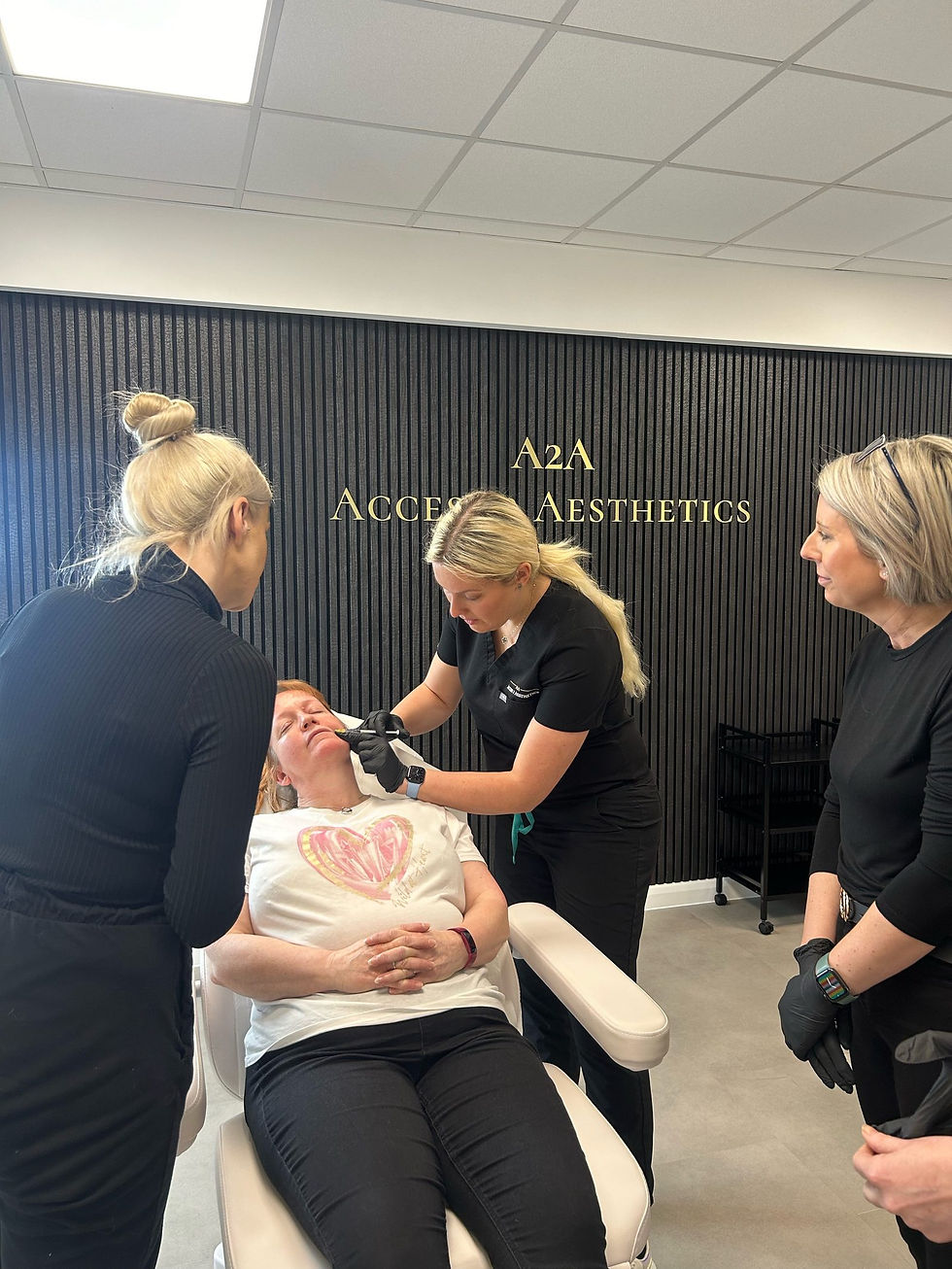
Look for training that goes well beyond the needle. Our Foundation courses cover facial anatomy, contraindications, the consultation process, face assessment and client selection, product preparation, treatment planning and marking up, pain management, adverse effects, complications management, aftercare and follow-up, health and safety, and emergency kit advice.
Good training should also be something you can always revert back to when you need it. At A2A, your course materials and eLearning stay with you, so you can refresh your knowledge whenever you need to. You also have clinical support from our Clinical Training Director if an emergency arises, plus a support group of other nurses and medical professionals who all help one another.
How the training day works

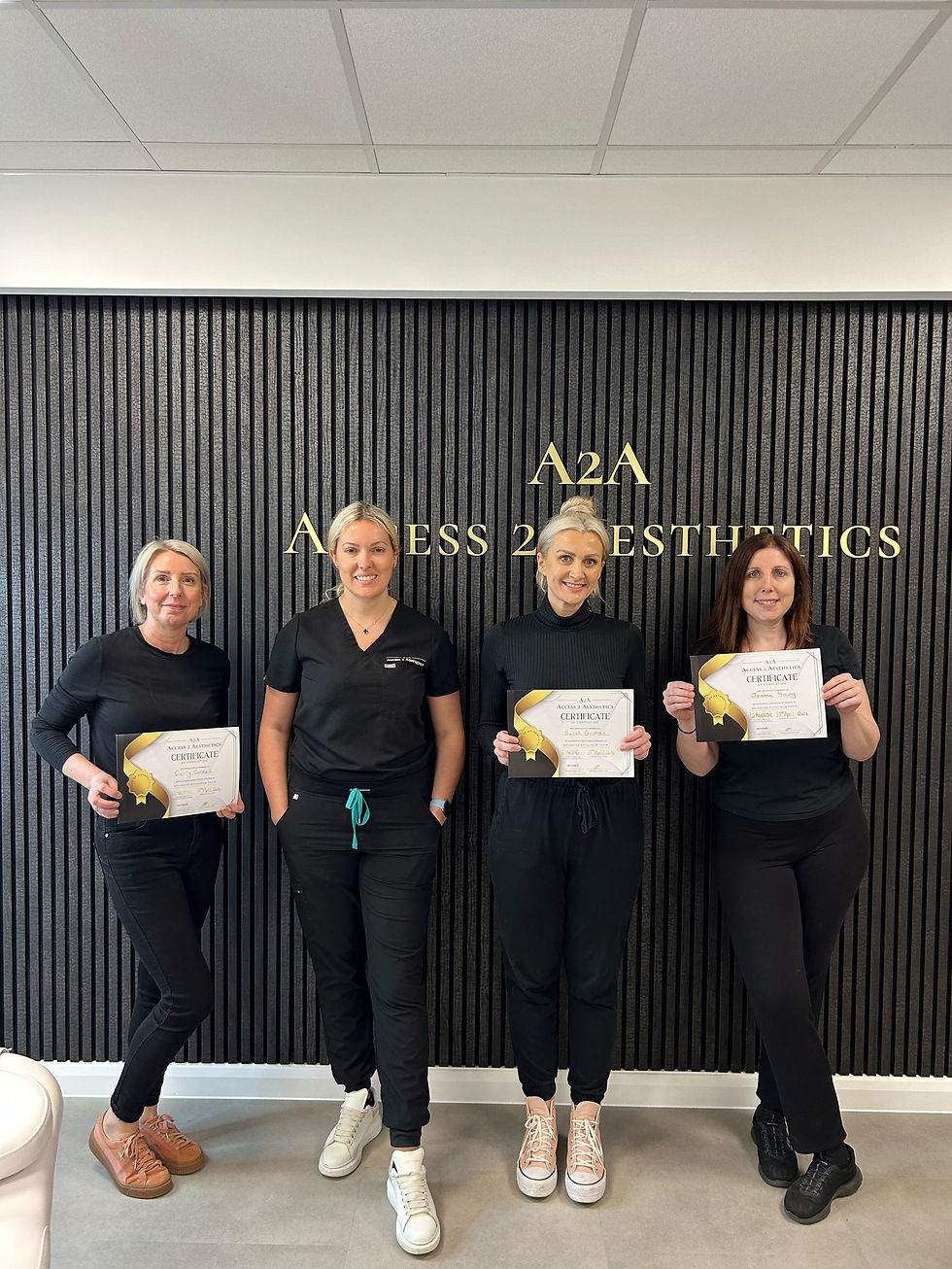
You start with theory at home on our eLearning platform, which also includes video treatment demonstrations and complications training. On the day, you recap the theory with your trainer, watch a live demonstration, practise on our simulator faces and then inject live models under supervision. The day finishes with a Q&A and your certificate presentation.

Class sessions let you learn alongside other medics, while a private 1:1 gives you your trainer's full attention.
Step 3: Prescribing – helpful, but not a blocker
Not being a prescriber yet is not an issue, and it won't stop you getting into aesthetics. Being able to prescribe helps the fluidity of your clinic, and the nurses we train typically start without it, build their clinic up, then aim to take the V300 within two to three years, using their clinic profits to fund it. Botulinum toxin (Botox) is a prescription-only medicine, so your toxin clients need a prescription from a qualified prescriber. If you can't prescribe yet, prescribers in the A2A support group can assist you with your toxin clients.
Dermal filler does not require a prescription, and neither do skin treatments, so you can build your clinic around these from day one. They still carry real risks, so the same standard of training, insurance and complication planning applies.
Optional next step: the V300 Prescribing Course
Once their clinic is established, many of the nurses we train aim to qualify as independent prescribers through the V300 Prescribing Course, typically within two to three years, funding it from their clinic profits. It is entirely optional. You study the theory with a university, and A2A provides the supervised prescribing placement and mentoring that sits alongside it: 12 days (90 hours) of live prescribing clinics, for £2,250. You can read more on our V300 Prescribing Course page.
Step 4: Sort your insurance, pharmacy and paperwork
Before you treat anyone, you'll need insurance that covers the aesthetic treatments you provide, an account with a pharmacy that supplies aesthetic practitioners, and clear consent and aftercare forms. The NMC Code applies in aesthetics just as it does on the ward.
After an A2A course, you'll find insurance details, pharmacy details, consent and aftercare forms and our free Business Start-Up Guidance eBook on our online training platform, so you aren't starting from a blank page.
The rules for non-surgical cosmetic treatments are under review across the UK, so keep an eye on guidance from the NMC, your insurer and the government as it develops.
Step 5: Build your experience with support
Your first months are about steady, safe practice. Start with the treatments you've trained in, keep your diary manageable and ask for help whenever you need it. Every A2A delegate gets ongoing clinical and business support from our directors, plus access to our support community and WhatsApp group.

If you'd like more time in clinic, a Shadow Day lets you spend a full clinical day observing Helen at Pro-Juvenate Aesthetics, our sister clinic. A Mentorship Day brings Helen to your own clinic to guide you as you treat your patients. When you're ready to grow, Advanced courses such as Advanced Toxin and Advanced Dermal Filler build on your Foundation training.
Can you keep your NHS job?
You don't have to choose. Aesthetics can start as a small number of clients around your shifts and grow at a pace that suits you and your family. It's one of the questions we talk through most often at our Open Days, along with how to find your first clients and how to set up safely.
See it for yourself at our free Open Day
The easiest way to decide whether aesthetics is right for you is to see it up close. Our next free Aesthetics Career Open Day is on Sunday 24 January 2027, 10am to 1pm, at our new home: 20 Centre Court, Treforest Industrial Estate, Pontypridd CF37 5YR.
You'll watch live treatment demonstrations and can ask Helen and our CEO, Andrew Coombs, anything about training, prescribing and setting up your own clinic. Every attendee is entered into a prize draw to win a free Foundation Toxin course worth £650. The day is for medical professionals only.
Already know which course you want? Complete our Cardiff training booking form and a member of our team will be in touch to secure your training date.
Frequently asked questions
Do I need to be a prescriber to become an aesthetic nurse?
No. You don't need to be a prescriber to train or to start treating clients, and not being able to prescribe yet is not an issue. Dermal filler and skin treatments don't require a prescription. For toxin (Botox) clients, prescribers in the A2A support group can assist you. Being able to prescribe helps the fluidity of your clinic, so the nurses we train typically build their clinic up first, then aim to take the V300 Prescribing Course within two to three years, funded by their clinic profits.
Can a newly qualified nurse train in aesthetics?
At Access 2 Aesthetics, nurses and midwives can train as soon as they hold their NMC PIN. We recommend building your confidence steadily after your Foundation course and using the support that comes with it.
Can midwives train in aesthetics?
Yes. We train NMC-registered nurses and midwives, as well as doctors, dentists, dental hygienists and therapists, paramedics, ODPs, physiotherapists and other allied health professionals, and pharmacists.
How long does Foundation aesthetics training take?
You complete pre-course theory at home on our eLearning platform, then attend a practical training day. The Combined Foundation Toxin & Dermal Filler course runs as one extended day. Exact times vary by course, so we confirm them with you when you book. For class sessions, the timings also depend on how many students are booked on the day.
How much does Foundation training cost?
Class sessions cost £650 for Foundation Toxin, £700 for Foundation Dermal Filler and £1,200 for the Combined course. Private 1:1 sessions are £1,050, £1,100 and £1,600. PayPal Pay in 3 is available. See our Cardiff price list for every course.
Where does the training take place?
All our practical training takes place at our training clinic in Treforest, near Cardiff. Medical professionals travel to train with us from all over the UK.


Comments